
The 369 method is simple enough to explain in a sentence: write your intention three times in the morning, six times in the afternoon, nine times at night. What makes it worth doing is not the numbers. It is the structure they impose.
Where the numbers come from
The method borrows its numbers from Nikola Tesla, who is frequently quoted as having said that 3, 6 and 9 were the key to the universe. The attribution is shaky and the physics is not really the point.
What matters practically is that three, six and nine are small enough to actually do and awkward enough that you have to stop and think about when you are doing them. A method you can complete without noticing is a method you will stop noticing.
Free download
Weekly Planner Templates
Four printable pages to bring your week back into focus — a weekly overview, intentions and gratitude, a habit tracker, and a weekly reflection. Undated, so you can print them again every week.
How to actually run it
Pick one intention. One. Written in the present tense, specific enough that you would know if it happened, and believable enough that some part of you does not immediately object.
Morning, three times, before the day starts talking. Afternoon, six times, usually the hardest slot to protect. Night, nine times, last thing. Same sentence every time, written by hand.
Most people run it for thirty-three or forty-five days. Neither number is magic. What both do is commit you past the point where novelty carries you, which is around day nine.
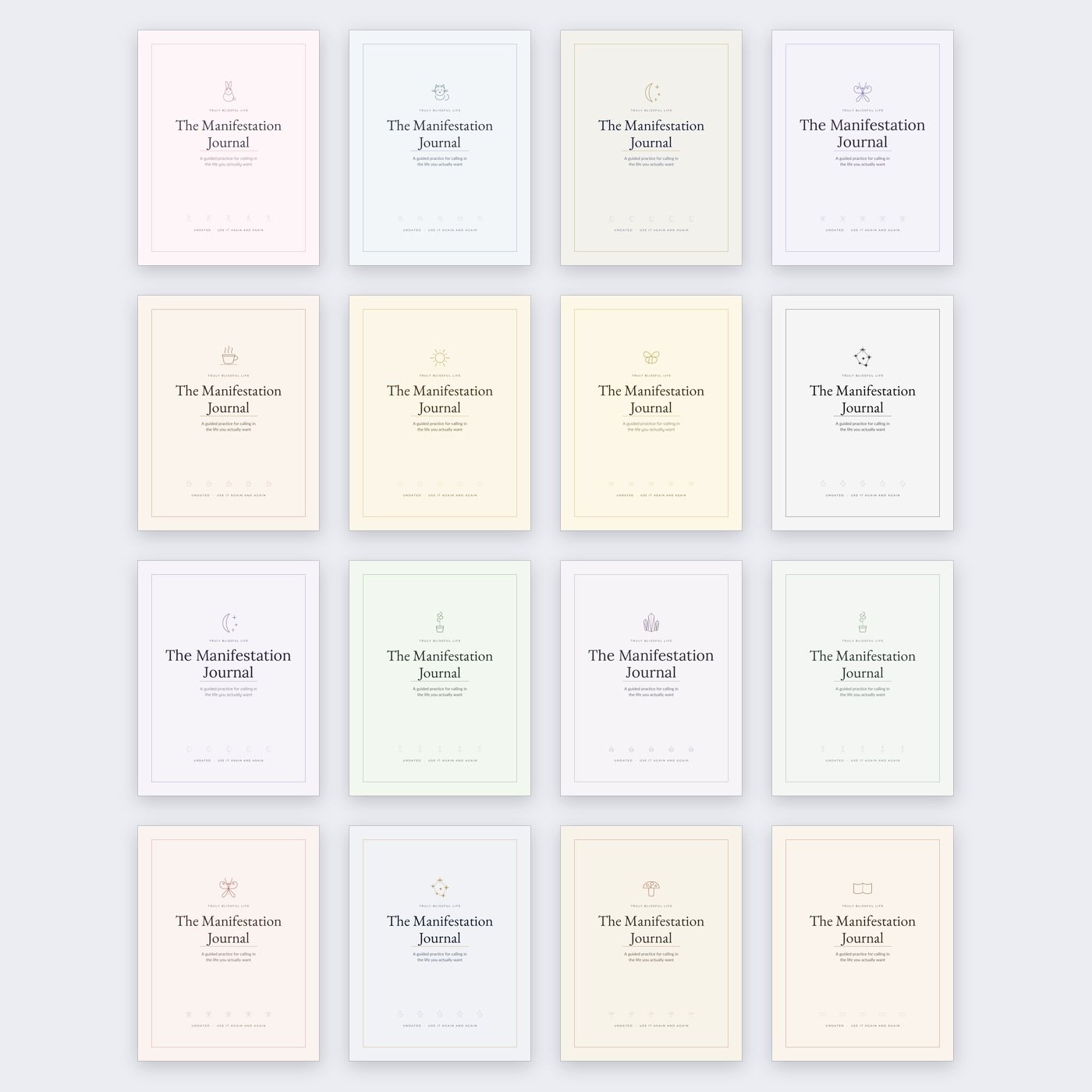
Eighteen lines a day for as long as you keep going is more writing than it sounds, and loose paper is how people lose the thread on day four — The Manifestation Journal keeps the whole run together.
Why the afternoon block is the one that matters
Morning and night are easy to attach to routines you already have. The afternoon six is the one that requires you to interrupt a working day on purpose, and it is the one people quietly drop first.
It is also the one doing the most work. An intention you only touch at the edges of the day stays theoretical. One you have to stop for at two in the afternoon starts affecting the decisions you make at three.
Write it so it survives contact with a bad day
The sentence you can write on a good morning is not always the sentence you can write on day twelve when nothing has happened. If yours makes you flinch by the end of the first week, it is pitched too far from where you actually are.
Soften it by one degree rather than abandoning it. “I have a job I love” becomes “I am moving toward work I am glad to do.” Same direction, and you can still write it honestly when you are tired.
The part everyone skips
Log what happens. Not just whether you completed the day — what showed up. The conversation, the email, the thing you noticed. Write the date next to it.
Without that, at the end of forty-five days you have a lot of repetition and no evidence, and you will conclude it did not work because you cannot remember. With it, you can see the run of small things that you would otherwise have filed as coincidence.
What the method is actually doing
Strip out the numerology and there is a fairly recognizable mechanism underneath, which is worth knowing because it tells you which parts matter and which are decoration.
Writing the same statement repeatedly, at spaced intervals across a day, is distributed rehearsal. It is one of the better-supported findings in how people retain and internalize material, and it is the reason three sessions of six beat one session of eighteen.
The morning and evening placement is not arbitrary either. Those are the two points where you are closest to sleep, and material handled around sleep is consolidated differently than material handled at two in the afternoon.
And the act of writing by hand slows you to roughly the speed of thought, which is why people who switch to typing frequently report it stops working. It has not stopped working. It has stopped being slow enough to notice what you are writing.
When it is not working
Three common failures, all fixable.
The statement is too far from believable. If some part of you rejects the sentence outright, the sessions become an argument rather than a rehearsal, and you spend three weeks reinforcing the objection. Bring the claim closer until it sits at the edge of plausible rather than well beyond it.
It has become recitation. After ten days the words go automatic and the attention leaves. The fix is to change the wording slightly every few days while keeping the meaning, which forces you to actually read what you are writing.
There is no action attached. This is the big one. A practice that runs entirely inside a notebook can continue indefinitely without touching your life. End every evening session with one line: the smallest real-world step this implies, done within a day. That single addition is what separates the people for whom this works from the people for whom it is a pleasant habit.
From the shop
The Manifestation Journal
Pages for scripting, repetition work and the methods that need consecutive days, with room to record what actually happened.
Get the journal — $14