
The equinox is the one day of the year when light and dark are the same length, and after it the dark half wins by a little more every day until December. You do not have to believe anything mystical about that for it to be useful. It is a naturally occurring deadline, and deadlines are what make people finally put something down.
Why the equinox is a better time to release than New Year
January asks you to add things. New habits, new goals, a new version of yourself, all starting on a Monday in the coldest, darkest, most tired week of the year. It is a terrible time to ask anything of yourself, which is why most of it is abandoned by February.
The autumn equinox asks the opposite question. Not what are you taking on, but what are you not carrying through the winter. That is a much easier question to answer honestly, and it leaves you lighter going into the months that are genuinely harder.
Harvest festivals across most of the northern hemisphere land here for the same practical reason: this was the moment you found out what the year had actually produced, and what had failed. Nobody pretended the failed crop had worked. They counted it, and then they planned around it.
Free download
Weekly Planner Templates
Four printable pages to bring your week back into focus — a weekly overview, intentions and gratitude, a habit tracker, and a weekly reflection. Undated, so you can print them again every week.
Start with an honest inventory, not a ritual
Before any candle gets lit, write three lists. They take about twenty minutes and they do most of the work.
What actually grew this year. Not what you meant to grow. What is measurably further along than it was in January. Be specific and be generous — people routinely forget the thing they were agonising over in March that is now just part of their life.
What did not. The project that stalled, the habit that never took, the relationship that stayed exactly where it was. No explanations in this list. Explanations are how things get carried forward for another year.
What you are still carrying that is not yours. Someone else’s opinion, an old version of yourself you keep arguing with, a plan you made for a life you no longer want. This is usually the shortest list and the heaviest one.
The point of marking the turn is that you can look back at what you wrote and see whether the thing you were carrying in September was still there in December — which is what Moon Phase Journal is built to show you.
A release ritual that is not just burning paper
Burning a piece of paper feels good for about four minutes. What makes it stick is deciding, in writing, what replaces the thing you are putting down — because a habit or a worry does not leave a gap, it leaves a vacancy that the same thing fills again by November.
So: take one item from the third list. Write it on paper. Underneath it, write the sentence you will use instead when it comes back — and it will come back. Then burn it, bury it, tear it up, whatever suits you. Keep the replacement sentence somewhere you will see it.
One item. Not the whole list. A release ritual with nine things in it releases nothing.
Mark the date so you can check it later
This is the part almost everyone skips, and it is the part that turns a nice evening into something with evidence behind it. Write the date. Write what you put down. Then set a point in the future — the solstice in December is the obvious one — to read it back.
Most of the value of any of this arrives months later, when you read a page from September and realise the thing that felt enormous has quietly stopped mattering. You cannot notice that unless you wrote it down at the time.
What to do with the dark half
The months between now and the solstice are not a waiting room. They are the part of the cycle where things happen underground and nothing visible grows, which is genuinely useful if you stop measuring yourself by visible growth for a few months.
Practically, that means: fewer new commitments, more finishing. Less starting, more sorting. And a record you can keep, so that when the light comes back in January you are planning from what actually happened rather than from what you can remember.
What the equinox actually is
The autumn equinox is the point at which day and night are close to equal, and after which the nights are longer than the days for the next six months. It is not a gradual mood, it is a measurable turn, and it happens on a specific date whether or not anyone marks it.
That equality is where the symbolism comes from. For a day or so, the light and the dark are balanced, and after that the balance tips. Every tradition that marks this date reads it the same way: a moment of even weighing, followed by a decision about what goes into the dark with you.
It is also the second of the three harvest points in the old agricultural year. The work is done, the result is in, and what is in the barn is what you have. That is a more useful frame for a September review than the January one, because it asks what you got rather than what you intend.
If nothing obvious comes up
Some years you sit down to do this and there is nothing. No grievance, no obvious weight, nothing you can name that wants to go.
That usually means one of two things. Either it has been a genuinely settled year, which happens and is worth writing down as a fact rather than skipping past, or the thing is large enough that you are not looking at it directly.
The test for the second is physical. Read down a list of the main areas of your life, slowly, out loud: work, money, home, health, the people closest to you, the thing you do for yourself. Notice which one produces a change in your breathing or a wish to move on quickly. That is where it is.
You do not have to open it tonight. Write the word down, close the notebook, and come back to it at the next dark moon. Naming the area without working it is a legitimate piece of work and it is a great deal better than deciding there is nothing there.
From the shop
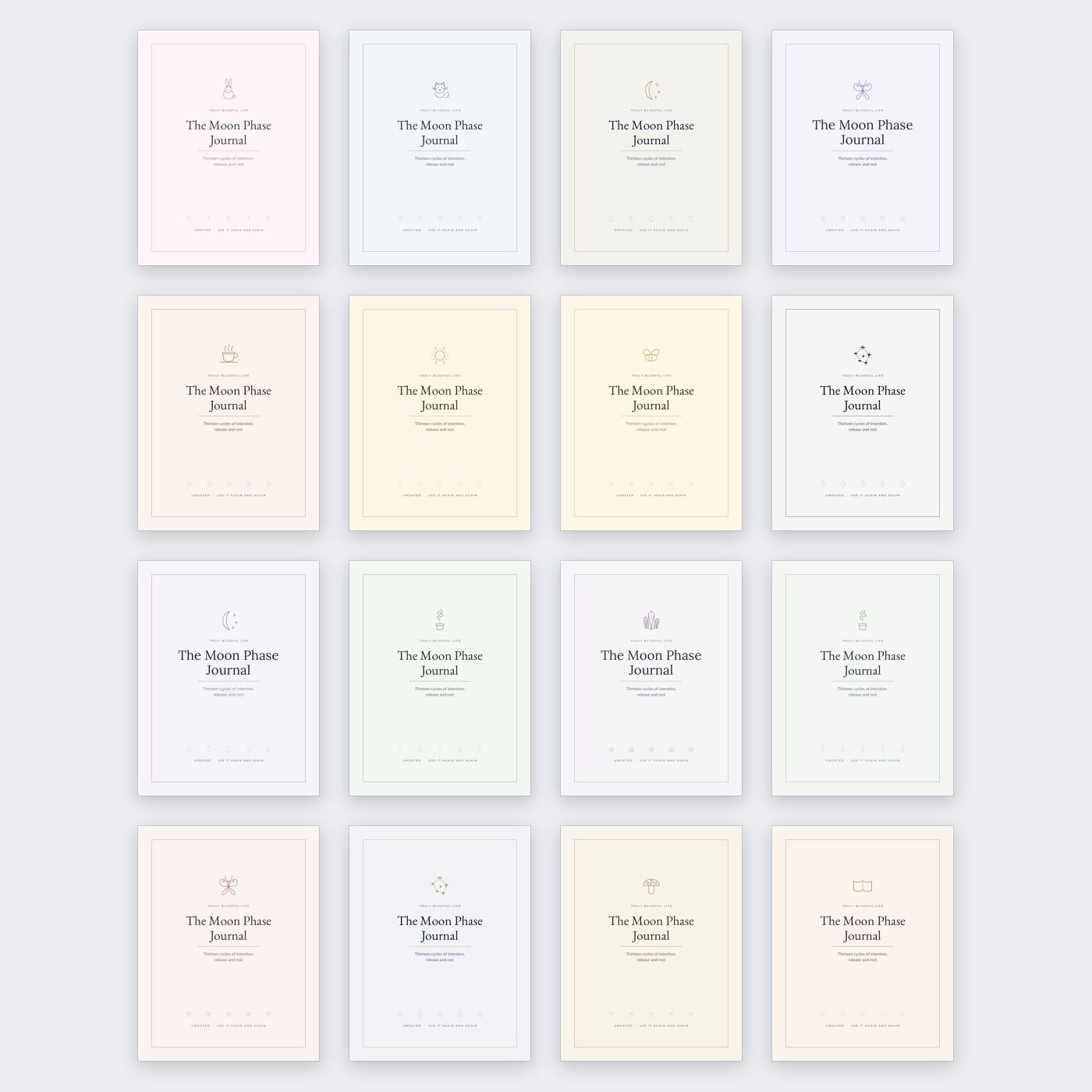
Moon Phase Journal
A full lunar cycle to work with — phase by phase, what to set down and what to pick up, with space to record what actually shifted.
Get the journal — $12