
Some links below go to Amazon. If you buy through one, I may earn a small commission at no extra cost to you — it does not change what I recommend or what anything costs.
Why the Standard Version Fails
The classic instruction is to list three things you are grateful for each day. It works in studies because in studies people do it for a fixed period under observation. It fails in life for three reasons.
The first is repetition. Your list converges on the same five items by the end of week one, and writing the same thing down is not a practice, it is a chore.
The second is abstraction. My family is not a thought. It is a category. Categories do not produce any feeling, and gratitude that produces no feeling is just bookkeeping.
The third is timing. Most people do it at night when they are tired and want to be asleep, which guarantees the shortest and laziest possible answer.
The Fix: Get Absurdly Specific
Change the question from what are you grateful for to what happened today that you would not want to forget.
That single shift solves the repetition problem, because the answer is different every day by definition. It also forces detail. Instead of my sister, you write the way my sister said absolutely not on the phone when I told her what he said. That sentence carries the feeling. The category never did.
A good specificity test: could this entry have been written by anyone else on earth? If yes, it is too broad. Go smaller until it could only be yours.
Free download
Weekly Planner Templates
Four printable pages to bring your week back into focus — a weekly overview, intentions and gratitude, a habit tracker, and a weekly reflection. Undated, so you can print them again every week.
Pick a Format You Will Not Resent
There are three formats that survive past a month, and it is worth knowing which kind of person you are before committing.
One line, every day. Best for people who will not do more. The bar has to be genuinely low, meaning one sentence counts as done and you do not get to feel bad about it.
A full page, three times a week. Better for people who need room to get somewhere. Daily entries by a natural writer become perfunctory. A Monday, Wednesday, Friday page tends to go deeper.
Weekly, with a review. For people whose weekdays are not their own. One long Sunday entry looking back across seven days, plus a line about what you want to notice more of in the week ahead.
Pick one and hold it for a month before switching. Format-hopping is the most common way this dies.
The prompts that keep working are the specific ones, which is exactly what a blank page will not give you. The The Gratitude Journal supplies a different prompt for each day, so you are not writing family and coffee for the eleventh time.
What to Do When It Feels Fake
It will, especially if you start during a bad stretch. Forced gratitude in the middle of grief or burnout feels like lying, and if you push through it by insisting harder, you will quit.
Two adjustments help. First, allow a both-things entry. Today was awful and the soup was good. You do not have to resolve the contradiction, and pretending the awful part is not there is what makes it feel dishonest.
Second, on the worst days, drop gratitude entirely and write one neutral observation instead. The light in the kitchen at four. The practice you want is noticing, and gratitude is one flavor of noticing. On a hard day, keep the noticing and drop the requirement to feel good about it.
Stacking It Onto Something You Already Do
New habits attach to existing ones far more reliably than they stand alone. Find something you already do without deciding to, and put the journal physically in its path.
The kettle is the classic one. Write while it boils. It is a natural two-minute window, it happens at the same time daily, and the constraint keeps entries short enough to be sustainable. Others that work: in the car before you go into the house, at the desk before you open email, on the sofa before the first episode.
Whatever you choose, the notebook lives there. Not in a drawer. The friction of retrieval is more often responsible for a dead habit than any lack of motivation.
How to Tell If It Is Working
Do not measure by whether you feel grateful. That is too noisy day to day and it will make you think you are failing.
Measure two other things. First, are you catching things in the moment? The real marker is when you notice something at two in the afternoon and think, that is going in the journal. That means the filter has moved into your day rather than living at the end of it.
Second, reread a month later. You will find entries you had entirely forgotten, and the fact that you forgot them is the argument for the practice. Most of a life is made of things you did not bother to keep.
What to keep it in
Loose printed pages get lost, and that is a large part of why a practice like this dies in week three. If you are printing the The Gratitude Journal, the cheapest setup that lasts is a slim three-ring binder and a pack of sheet protectors, so the pages you write on stay put and the reference pages stay clean.
A disc-bound notebook is the better choice if you want to add pages, reorder them, or pull one out to carry with you. Either way the point is the same: it lives in one place you can reach without going to look for it.
Further reading
If you want the research rather than the advice:
- Thanks! How Practicing Gratitude Can Make You Happier — Robert Emmons. The psychologist whose studies most of the popular gratitude advice is drawn from.
From the shop
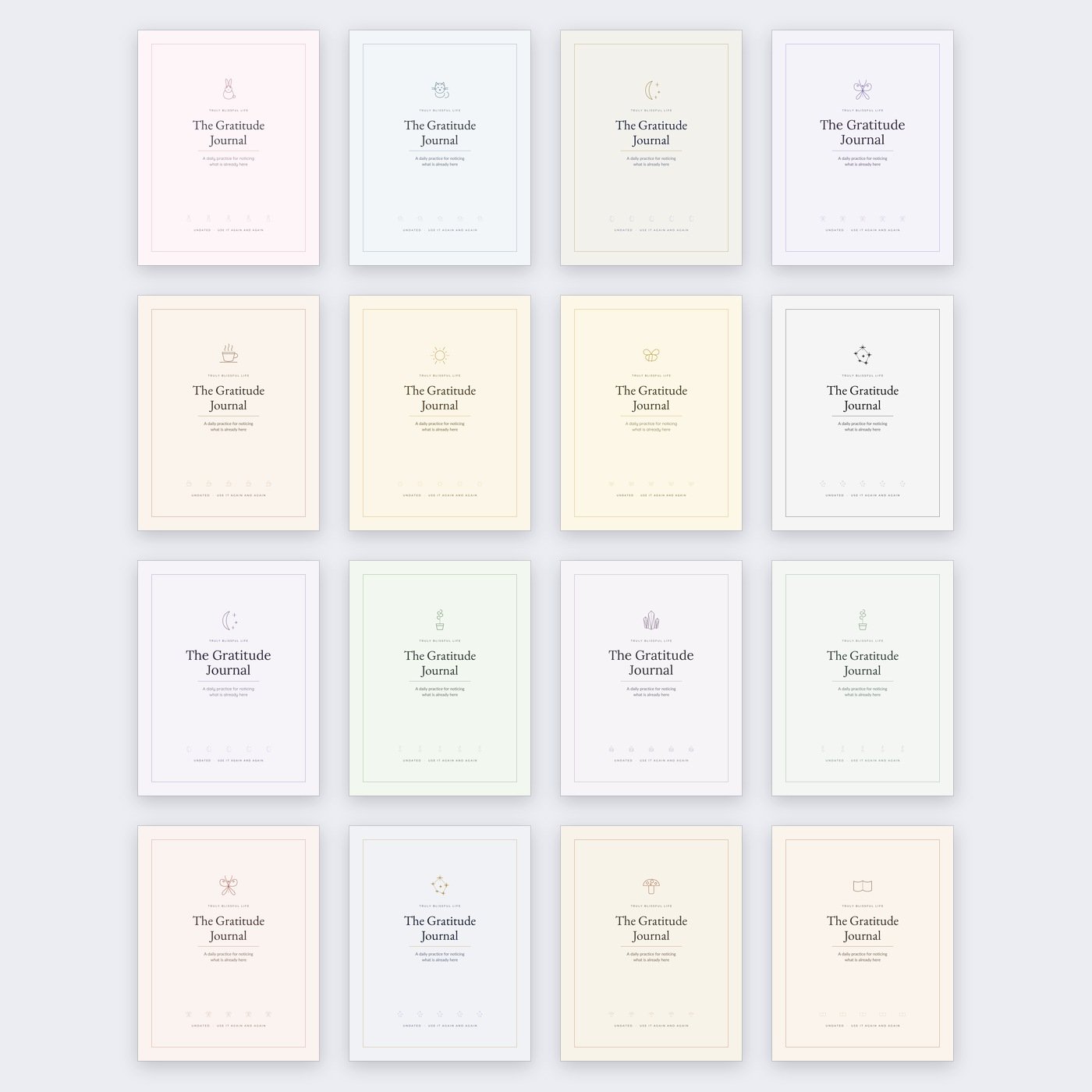
The Gratitude Journal
Prompts specific enough to produce a real answer, with room for the detail that makes an entry worth rereading a month later.
Get the journal — $12